Saturday, March 10, 2018

Psalm 55

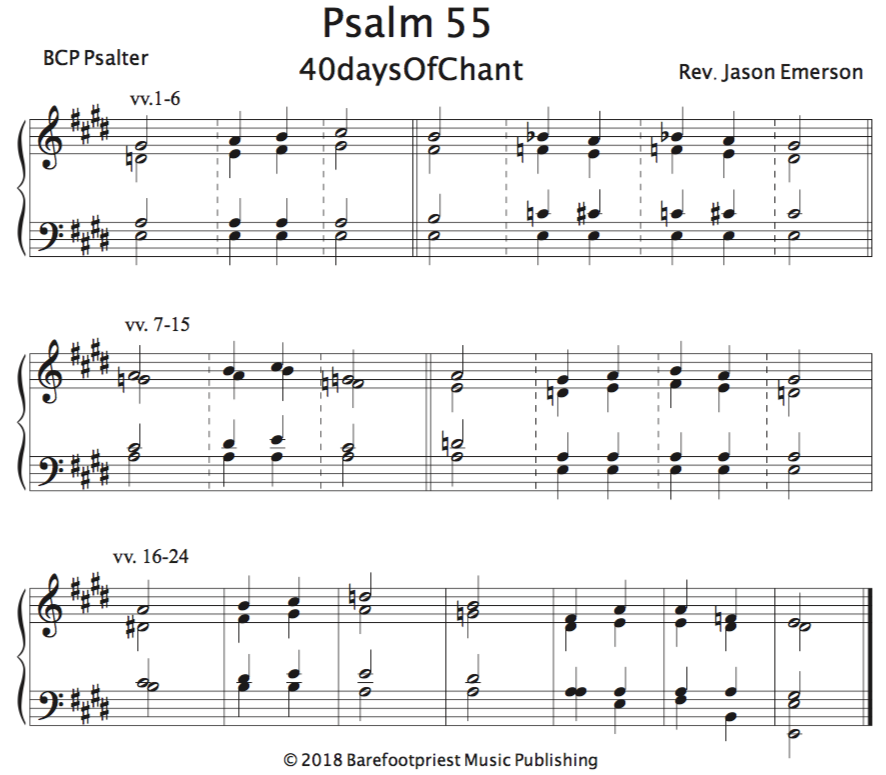
This Psalm is long, and when I read it I saw three fairly over sections.  Also, it has a pleading tone, which made me think of the blues.  So, I split the psalm into three sections and roughly the harmony, at least the bass line, corresponds with the three harmonic sections of a twelve bar blues.  However, the psalmist doesn't seem to be on sure footing.  There is a liminal or unsure tone to the psalmist's pleas.  To represent this harmonically I used a lot of parallel motion or so-called "chord planing" a la Revel's impressionistic music.  


Friday, March 9, 2018

Psalm 54


1. Save me, O God, | by your | Name; *
    in your | might, de- | fend my | cause.

2. Hear my | prayer, O | God; *
    give ear to | the words | of my | mouth.

3. For the arrogant have risen up against me,
    and the ruthless have | sought my | life, *
    those who have | no re- | gard for | God.

4. Behold, God | is my | helper; *
    it is the | Lord who | sustains my | life.

5. Render evil to those who | spy on | me; *
    in your faith- | fulness, | destroy |them.

6. I will offer you a | freewill | sacrifice *
    and praise your Name, O | LORD, for | it is | good.

7. For you have rescued me from | ever-y | trouble, *
    and my eye has seen | the ruin | of my | foes.

Thursday, March 8, 2018

Psalm 53

For reasons I have yet to discern, reading Psalm 53 made me think of Oliver Nelson's minor blues tune Cascades from his album Blues and the Abstract Truth.  So, I decided to quote the first ten notes of the melody as the soprano line of the chant.  


1. The fool has said in his heart, "There | is no | God." *
    All are corrupt and commit abominable acts;
    there is | none who | does any | good.

2. God looks down from heaven | upon us | all, *
    to see if there is any who is wise,
    if there is | one who | seeks after | God.

3. Everyone has proved faithless;
    all alike | have turned | bad; *
    there is none who | does good; | no, not | one.

4. Have they no know- | ledge, those | evildoers *
    who eat up my people like bread
    and | do not | call upon | God?

5. See how greatly they tremble,
    such trembling as | never | was; *
    for God has scattered the bones of the enemy;
    they are put to shame, because God | has re- | jected | them.

6. Oh, that Israel's deliverance would come | out of | Zion! *
    when God restores the fortunes of his people
    Jacob will re- | joice and | Israel be | glad.

Wednesday, March 7, 2018

Psalm 52

This psalm is angry.  There is just no two ways about it, the author was angry, expresses anger, and is far from happy.  However, as with several psalms, the mood shifts in the last two verses. The poet is no longer admonishing the proud; rather the poet effusively praises God.  To portray both of these emotional characteristics musically I wrote two sections.  The first section is dissonant with lots of crunchy chords. The second section has the same soprano and bass lines, but the harmonies are both more consonant and traditionally functional. 


1. You tyrant, why do you | boast of | wickedness *
    against the | godly | all day | long?

2. You plot ruin;
    your tongue is like | a sharpened |  razor, *
    O |worker | of de- | ception.

3. You love evil | more than | good *
    and lying | more than | speaking the | truth.

4. You love all | words that | hurt, *
    | O you | deceitful | tongue.

5. Oh, that God would de- | molish you | utterly, *
    topple you, and snatch you from your dwelling,
    and root you out of | the land | of the | living!

6. The righteous shall | see and | tremble, *
    and they | shall laugh | at him, | saying,

7. "This is the one who did not take God | for a | refuge, *
    but trusted in great wealth and | relied | upon | wickedness."

8. But I am like a green olive tree in the | house of | God; *
    I trust in the mercy of | God for | ever and | ever.

9. I will give you thanks for what | you have | done *
    and declare the goodness of your Name in | the presence | of the | godly.

Monday, March 5, 2018

Psalm 51

This is probably THE Lenten Psalm of all the Psalms; so, I tried to make it penitential.  I'm not sure if the second chord on the second line works, but nonetheless, I'm sticking with it. 


Monday, February 26, 2018

Psalms 47 and 48


1.   Clap your hand, | all you | peoples;*
         shout to God | with a | cry of | joy.

2.   For the Lord Most High is | to be | feared;*
         he is the great King | over | all the | earth.

3.   He subdues the peoples under us,*
         and the | nations | under our | feet.

4.   He chooses our inheri- | tance for | us.*
         the pride of | Jacob | whom he | loves.

5.   God has gone up | with a | shout,*
         the Lord with | the sound | of the | ram's-horn.

6.   Sing praises to God, sing praises;*
         sing praises to our King, sing praises.

7.   For God is King of all the earth;*
         sing prai- | ses with | all your | skill.

8.   God reigns | over the | nations;*
         God sits | upon his | holy | throne.

9.   The nobles of the peoples have | gathered to- | gether;*
         with the people | of the | God of | Abraham.

10. The rulers of the earth | belong to | God,*
         and | he is | highly ex- | alted.


1.   Great is the LORD, and highly | to be | praised; *
         in the city of our God is his holy hill.


2.   Beautiful and lofty, the joy of all the earth, is the | hill of | Zion, *
         the very center of the world and the | city of | the great | King.

3.   God is | in her | citadels; * 
         he is known | to be | her sure | refuge.

4.   Behold, the kings of | the earth | assembled * 
         and | marched for- | ward to- | gether.

5.   They looked and | were a- | stounded; *
         they re- | treated and | fled in | terror.

6.   Trembling | seized them | there; * 
         they writhed like a woman in childbirth, 
         like ships of the sea when the | east wind | shatters | them.

7.   As we have heard, so have we seen,
         in the city of the LORD of hosts, in the city | of our | God; *
         God has | es- tablished | her for- | ever.

8.   We have waited in silence on your  | loving-kindness, O | God, * 
         in | the midst | of your | temple.

9.   Your praise, like your Name, O God, reaches to | the world's | end; *
        your right | hand is | full of | justice.

10. Let Mount Zion be gladand the cities of | Judah | rejoice, *
        be- | cause of |your judg- | ments.

11. Make the circuit of Zion; walk | round about | her; *
        count the | number | of her | towers.

12. Consider well her bulwarks; | examine her | strongholds; *
        that you may | tell those | who come | after.

13. This God is our God for- | ever and | ever; * 
he shall | be our | guide for | evermore.


Wednesday, February 21, 2018

Psalm 44


Psalm 43


1.   Give judgment for me, O God, 
        and defend my cause against an un- | godly | people; *
        deliver me from the de- | ceitful | and the | wicked.

2.   For you are the God of my strength; why have you put | me from | you?*            and why do I go so heavily while the | ene-my | oppress- es | me?

3.   Send out your light and your truth, that they | may lead | me, * 
         and bring me to your holy | hill and | to your | dwelling;

4.   That I may go to the altar of God, to the God of my | joy and | gladness; * 
         and on the harp I will give thanks to | you, O | God my | God.

5.   Why are you so full of heaviness, | O my | soul? * 
         and why are you so dis- | quieted | within | me?

6.   Put your | trust in | God; * 
         for I will yet give thanks to him,
         who is the help of my | counte- nance, | and my | God.


Monday, February 19, 2018

Psalm 42


1.   As the deer longs | for the | water-brooks, *
        so longs my |soul for | you, O | God.

2.   My soul is athirst for God, athirst for the | living | God; *
        when shall I come to appear be- | fore the | presence of | God?

3.   My tears have been my food day and night, * 
        while all day long they say to me, | Where now |is your | God?"

4.   I pour out my soul when I think | on these | things; *
        how I went with the multitude and led them | into the | house of | God, 

5.   With the voice of | praise and | thanksgiving, *
        among those |who keep | holy | day.

6.   Why are you so full of heaviness, | O my | soul? *
        and why are you so dis- | quieted | within | me?

7.   Put your | trust in | God; * 
        for I will yet give thanks to him, 
        who is the help of my | countenance, | and my | God.

8.   My soul is heavy | within | me; *
        therefore I will remember you from the land of Jordan 
        and from the peak of Mizar | among the | heights of | Hermon.

9.   One deep calls to another in the noise | of your | cataracts; *
        all your rapids and floods | have gone | over | me.

10. The LORD grants his loving-kindness | in the | daytime; *
        in the night season his song is with me, 
        a prayer | to the | God of my | life.

11. I will say to the God of my strength, "Why have you | for- gotten | me? *
        and why do I go so heavily | while the | enemy oppresses | me?"

12. While my bones | are being | broken, *
        my enemies | mock me | to my | face;

13. All day long | they mock | me *
        and say to me, |"Where now | is your | God?"

14. Why are you so full of heaviness, | O my | soul? *
        and why are you so | dis- quieted | within | me?

15.  Put your | trust in | God; *
        for I will yet give thanks to him, 
        who is the help of | my countenance, | and my | God.


Saturday, February 17, 2018

Psalm 41

1.  Happy are they who consider the | poor and | needy! *
        the LORD will deliver them | in the | time of | trouble.

2.  The LORD preserves them and keeps them alive,
        so that they may be happy | in the | land; *
        he does not hand them over | to the will | of their | enemies.

3.  The LORD sustains them | on their | sickbed *
        and ministers | to them | in their | illness.

4.  I said, "LORD, be | merciful to | me; *
        heal me, for I | have sinned | a- gainst | you."

5.  My enemies are saying wicked | things a- | bout me: *
        When will he | die, and | his name | perish?"

6.  Even if they come to see me, they speak | empty | words; *
        their heart collects false rumors; they | go out- | side and | spread them.

7.  All my enemies whisper together | about | me *
        and devise | evil | against | me.

8.  "A deadly thing," they say, "has | fastened on | him; *
        he has taken to his bed and will | never get | up a- | gain."

9.  Even my best friend, whom I trusted, who broke | bread with | me, *
        has lifted up his | heel and turned | against | me.

10. But you, O LORD, be merciful to me and | raise me | up, *
         and | I shall | repay | them.

11. By this I know you are | pleased with | me, *
         that my enemy does not | triumph | over | me.

12. In my integrity you | hold me | fast, *
         and shall set me be- | fore your | face for- | ever.

13. Blessed be the LORD | God of | Israel, *
         from | age to age. | Amen. | Amen.

Friday, February 16, 2018

Psalm 40

I actually wrote this yesterday, but I did not get it posted last night.  So, I'm still on track with my Lenten discipline.  I tried to write this one in Phrygian mode.  I will always remember Lauren Hill reading this Psalm at the Grammy's in her acceptance speech.  I wanted to convey both the adversity of trials and hardship, along with the joy of deliverance. 


1. I waited patiently u- | pon the | LORD;*
he stooped to | me and | heard my | cry.

2. He lifted me out of the desolate pit, out of the | mire and | clay; *
he set my feet upon a high cliff and | made my | footing | sure.

3. He put a new song in my mouth, a song of praise | to our | God; *
many shall see, and stand in awe, and put | their trust | in the | LORD.

4. Happy are they who | trust in the | LORD! *
they do not resort to evil | spirits or | turn to false | gods.

5. Great things are they that you have done, O LORD my God! 
how great your wonders and your | plans for | us! *
there is none who can | be com- | pared with | you.

6. Oh, that I could make them known | and tell | them! *
but they are | more than | I can | count.

7. In sacrifice and offering you | take no | pleasure *
(you have gi- | ven me | ears to | hear you);

8. Burnt-offering and sin-offering you | have not re- | quired, *
and so I | said, "Be- | hold, I | come.

9. In the roll of the book it is written con- | cerning | me: *
'I love to do your will, O my God; your | law is | deep in my | heart.'"

10. I proclaimed righteousness in the great | congre- | gation; * 
behold, I did not restrain my lips; | and that, O | LORD, you | know.

11. Your righteousness have I not hidden in my heart;
I have spoken of your faithfulness and | your de- | liverance; *
I have not concealed your love and faithfulness | from the great | congre- | gation.

Wednesday, February 14, 2018

Forty Days of Chant, Psalm 39

Three years ago, for my Lenten discipline, I wrote an Anglican Chant for a psalm every day. I had intended to complete 40 chants for the first 40 Psalms in the 40 days of Lent.  You can see those chants in earlier posts on this blog.  Alas, I made it to Psalm 38.  Fortunately, failing at a Lenten discipline just allows us to repent and once again experience the forgiveness of God.

I'm picking up where I left off for my discipline this year.  I ask your prayers as I once again attempt to write forty chants in forty days.  Below is today's chant on Psalm 39.  I wrote a single chant that moves from c-minor to c-major because the verses of the psalm frequently express multiple emotions in a single verse.  For example, verses 5-7 expound upon the shortness and transience of life.  Then verse 8 reads,
And now, what is my hope?
     O Lord, my hope is in you.
The despairing question of the first line is followed by the assured declaration of the second.


1.  I said, "I will keep watch up- | on my ways,*
       so that I do not | of-fend | with my | tongue.

2.  I will put a muzzle | on my | mouth*
        while the wick- | ed are | in my | presence."

3.  So I held my tongue | and said | nothing;*
        I refrained from rash words; but my | pain be- | came un- | bearable.

4.  My heart was hot within me; while I pondered, the fire burst | into | flame;*
        I | spoke out | with my | tongue:

5.  Lord, let me know my end and the number | of my | days,*
        so that I may know | how short | my life | is.

6.  You have given me a mere handful of days and my lifetime is as nothing | in your | sight;*
        truly, even those who stand erect are | but a | puff of | wind.

7.  We walk about like a shadow, and in vain we | are in | turmoil;*
        we heap up riches and cannot tell | who will | ga- ther | them.

8.  And now, what | is my | hope?*
        O Lord, | my hope | is in | you.

9.  Deliver me from all | my trans- | gressions*
        and do not make | me the | taunt of the | fool.

10. I fell silent and did not | open my | mouth,*
        for surely it | was you | that did | it.

11. Take your af- | fliction from | me;*
        I am worn down | by the blows | of your | hand.

12. With rebukes for sin you punish us; like a moth you eat away all that is | dear to | us;*
        truly, everyone is | but a | puff of | wind.

13. Hear my prayer, O Lord, and give ear | to my | cry;*
        hold not your peace at my tears.

14. For I am but a | sojourner with | you,*
        a wayfarer, as | all my | forebears | were.

15. Turn your gaze from me, that I may be | glad a- | gain,*
        before I go my | way and | am no | more.


Thursday, November 16, 2017

Swing Change: Growing as a preacher over time.


Swing Change


There is an old saying that if you aren't growing you are dying.  I've been an Episcopal priest for almost 12 years now, and I have been actively preaching even longer.  I felt in the last few years that I was getting into a bit of a rut--using the same catch phrases, mining the same themes, and, most egregiously, ending almost every sermon the exact same way.  I wasn't growing as a preacher anymore, and my preaching was, therefore, in danger of dying on the vine.  

I have recently taken a new call as the Rector of the Episcopal Church of the Nativity in Fort Oglethorpe, GA.  So, I decided to seize the new context as a chance to overhaul my preaching.  It's equivalent to a long time golfer going through a swing change.  While this is an ongoing process, like a golf swing I am starting to find a new tempo and trajectory.  

Two new things in my preparation are sermon writing playlists and mind maps.  On the delivery side, I am making a commitment to preaching without a manuscript or notes.


Playlists


The Method


I actually started playing with this idea before I moved, but it's becoming more of a pattern and is beginning to bear fruit.  During the week, as I am meditating on the scriptures--wrestling with them until they yield a blessing, to paraphrase Phylis Tickle--I keep in mind what music comes to mind.  Then, on Thursdays, my sermon writing day, I compile those into a playlist that I play as I write.  If very few tunes came to mind, I'll go searching for tunes related to the themes of the potential sermon.


The Fruit


I was a musician before I was a priest, and I'm still a Christmas and Easter trumpet player, so music stimulates my brain.  This is probably true for everyone biologically, but for me, it is a developed phenomenon because of the decades of playing, listening, practicing, and performing music.  I am finding that both building the playlists and listening while I write helps me form connections between the sections of my sermons.  Thus improving my ability to preach from memory sans manuscript (more on manuscript preaching versus not below).

Mind Mapping


The Method


Mind Mapping was invented by Tony Buzan as a way of taking notes.  It has a lot of other uses which you can read about on his site.  Simply put, it is a way to draw an outline that is more organic than the traditional-linear-vertical outline.  You start with a central idea like "Sunday Sermon" in the middle of the page and then draw branches for major themes out from the central idea.  Then your draw branches off the branches for related ideas and continue to iterate as needed.  You can also add images. My mind map for this coming Sunday, November 19, 2017, is at the top of this post.  


The Fruit


I am finding that the more organic layout of Mind Maps, especially when using different colors and images, enables me to preach without a manuscript or notes.  Now, there is an ongoing debate as to whether preaching from a manuscript is better than preaching without one.  While listeners, of course, have their preferences, the fact is that you will find fantastic preachers who use a manuscript, such as Babara Brown Taylor, and those that do not.  It's more a matter of context and which skills the preacher possesses.  Nativity is a relatively small room and the pulpit is nondescript.  Also, in the interview process, the search committee emphasized that they wanted a rector to "lead from the middle".  Taking these things into account, I decided to preach exclusively from the floor instead of the pulpit while I'm here.  I had been using manuscripts on a music stand but it felt stifling and constricting.  Coupling that dynamic with my desire for a swing change I have begun searching for ways I can prepare to preach sans notes.  The Mind Map helps me memorize the sermon because it is more visual/spatial.  Consequently, by preaching without the manuscript, I am free to be more expressive and engaging.  Babara Brown Taylor is successful as a pure manuscript preacher because her writing is so strong.  But let's face it, very few people write on her level, and certainly not me.  

Now, I in no way want to suggest that my methods are how others should do things.  My hope is that folks are encouraged, if/when they find themselves in a preaching rut, to change their methods of prep and delivery to breath new life into their preaching.  I strongly encourage preachers to try new things.  Go and find the methods that spark your creativity, the ways you can self-trigger your gifts and creativity to better prepare and preach the gospel. 

Lastly, here's this week's sermon writing playlist:

Wednesday, November 15, 2017

I Thessalonians Teaching Series, Session 1 -- It's not about the end of the world!

Below is the script for a video teaching series I'm doing on Facebook Live. I'll post a link to the video at the bottom. 

Good afternoon, I’m Fr. Jason Emerson. This afternoon we are beginning a three-week study of some passages of scripture from St. Paul’s First Letter to the Thessalonians. The texts we’ll be exploring are also the epistle readings for the Sundays during the remainder of November. My intention is to give you a couple of brief thoughts each week to encourage your own reflections. Today I’m going share some background information about the letter in general, then discuss chapter 4 verses 13-18, the reading for this coming Sunday, November 12th.

Commonly dated between 49-51 this letter is both the earliest piece of writing included in the New Testament and the earliest of Paul’s letters that we have. Paul is regarded as the primary writer, though he is writing on behalf of his missionary team: Silvanus, Timothy, and himself. It is a safe assumption that Silvanus and Timothy not only agreed with Paul but presumably also taught the same thing. Therefore we are getting some of the earliest of Christian thought in general and Paul’s theology in particular. So, we can call this letter embryonic Pauline theology. Remember that description, embryonic Pauline theology, it will return later.

Now let’s focus on chapter 4 verses 13-18. This is the passage appointed from the lectionary for this coming Sunday, Nov. 12th. We are reading the end of the chapter and almost the end of the book. There are only five chapters in the book; so, my first encouragement to you is to read the whole letter. You can read it in a half hour or less, and it will give you a feel for how this passage fits into the logic of the whole letter.

So, the passage…

Paul writes:

"We do not want you to be uninformed, brothers and sisters, about those who have died, so that you may not grieve as others do who have no hope. For since we believe that Jesus died and rose again, even so, through Jesus, God will bring with him those who have died. For this, we declare to you by the word of the Lord, that we who are alive, who are left until the coming of the Lord, will by no means precede those who have died. For the Lord himself, with a cry of command, with the archangel's call and with the sound of God's trumpet, will descend from heaven, and the dead in Christ will rise first. Then we who are alive, who are left, will be caught up in the clouds together with them to meet the Lord in the air; and so we will be with the Lord forever. Therefore encourage one another with these words." ~ http://www.lectionarypage.net/YearA_RCL/Pentecost/AProp28_RCL.html#nt1

This passage obviously deals with what we commonly call the second coming of Christ or the end times. It’s one of the most challenging concepts of Christian theology, and sadly one of the most prominent. There is a lot of wonderment about the end times in culture, but on measure very little in scripture. Nonetheless, Paul gives a very detailed description of the Resurrection of the Dead.

Obviously, what Paul describes has not happened yet, and I am even willing to say I do not believe the Resurrection of the dead will happen the way Paul describes. I think it is important for us not to get caught up in the details of the Resurrection instead of Paul’s intentions of encouragement and hope. We need to keep our eyes on the forest, not the trees.

Remember this is early Christian thinking, early and embryonic Pauline thought. It was a common thought amongst the earliest of Christians that Jesus would return before the end of their lifetime. Obviously, as of Paul’s writing, this hasn’t happened and so they must through prayer and faith grow in their understanding and theology. Years later when Paul writes to the Philippians from a jail cell where he assumed his own death was imminent, he writes that in death he will be “with Christ,” implying something different than in his letter to the Thessalonians. It is safe to say, Paul’s theology matures over time.

Therefore, our theology, generally speaking, should mature over time. The point of this passage is hope and encouragement. Like Paul writes later in the Letter to the Romans the point is that no matter what happens to us, even death, we cannot be separated from the love of God in Christ Jesus.

So, I encourage you to take some time and ask yourself where you find Hope and Encouragement, where do you see evidence of God’s presence in your life right now? Paul’s last line is that we are to encourage each other. So, I’ll close by encouraging you to be encouraging to each other. Find creative and joyful ways to assure somebody today and every day that they can not be separated from God’s love. I’ll see you next week online, if not Sunday morning. Until then, may you always know, “God loves you, no matter what.”
Here's the video:

Wednesday, June 24, 2015

When a loaf of bread is prophetic.

This past Sunday a lot of preachers tried to address the tragic shooting and murder of nine members of Mother Emmanuel AME church by a self pro-ported white supremacist.  I commend all of these preachers for attempting to look out over the pews of their own faith community and speak cogently about an incomprehensible act of terror.  I commend my brothers and sisters for standing up and speaking out.  I mentioned the massacre in my sermon as well, but I feel a desire today to say more.

However, before I can say more, I think I should address the question, "Who am I to say anything at all?"  I mean on paper I am just another middle aged white dude who has grown up in a country that privileges middle aged white dudes.  So, do I have something to say, and if so, should I even say it at all?

I think I do have something to say because even though I am a middle aged white dude, that's not all the privilege I have.  For the last six and a half years I have been privileged to serve as the rector of the Episcopal Church of the Resurrection (CoR) in North Omaha, NE.  "North O" is the traditionally African-American part of Omaha, which suffers the brunt of systemic racism like many other traditionally African-American neighborhoods in cities all over this country.  More than the geography, more then the location of CoR, it is a privilege to be a part of CoR's history.  29 years ago the white parish of St. John's and the black parish of St. Philip's merged to form the Church of the Resurrection.   The merger was not out of an ideal of reconciling the races however.  No, the merger was about survival.  Both congregations, like so many in the Episcopal Church, had thrived in the 50s and 60s and then began to decline in the 70s and 80s; so much so that joining together was the only way to find a way forward.

It was not an easy way forward though.  It took almost 15 years or more for the people to come together, to no longer think of themselves as two faith communities worshiping together.  It took that long at least for folks to begin to think of themselves as one community, one "culturally diverse family united in God's love."

This is where the prophetic nature of a loaf of bread comes in.  See, we break bread together here at the Church of the Resurrection in complete and total defiance of the "powers that be".  The fallen forces of this world want us to be separate.  They want worship time on Sunday morning to remain, "the most segregated hour in America," as Dr. King said.  Therefore it is prophetic for us to gather around God's Altar and share in the bread and wine that are the body and blood of Christ.  It is prophetic because we then leave that altar to go and be the body and blood of Christ--taken, broken, blessed, and given--to a hurting world in deep need of God's love.

Now that last sentence, might just sound like preacher rhetoric, just nice sounding words that lack much behind them.  That is not the case, at least not in my own life and in the lives of the members of  the CoR faith community.  So much of American society keeps us separated by race and class.  However, praying with and for the members of CoR brings me into deep relationship not just with Black folks, but also Sudanese folks and Puerto Rican Folks, gay folks and straight folks, rich and poor.  If I wasn't serving alongside this faith community, my kids would not have African American Godparents and I wouldn't have a Sudanese Goddaughter.  We live our lives through the Church of the Resurrection as a prophetic vision of what God's Kingdom on earth should look like.

So, I think I have something to say about a way forward after Charleston, because it just as easily could have been CoR that the gunman walked into that night.  I humbly suggest three things we should all do next.  First, please know that systemic racism in this country is about more than a flag.  Certainly the Confederate Battle Flag should come down just as it never should have been raised over the state house in South Carolina.  However, the way that the conversation has been taken over by discussing the flag is a distraction from hearing the voices of those calling for change.  It is easier to talk about a flag than it is to look at our privilege as white people. It is easier to talk about a flag, then to be convicted by the forgiveness that some of the members of Mother Immanuel AME have already offered the shooter.

Which leads us to the second thing we should do: be convicted by grace.  Specifically the grace of God working through those profoundly forgiving members of Mother Immanuel AME.  To be real honest, I do not know if I could do that.  I love the people of CoR deeply and if someone harmed them, it would only be the power of God that could cause me to forgive such a criminal.  Watching and listening to the members of Mother Immanuel is convicting me to search my own heart and aspire to greater forgiveness.  And it should convict us all to do the same.

Lastly, and this is the lesson I have learned at the Church of the Resurrection: We should live together.  I don't just mean segregation should be unlawful.  I mean we should eat together and pray together like the early Christian communities.  I mean we should worship together on Sunday, work with each other during the week, and fellowship with each other on the weekends.  I mean we need to go to the school programs and little league games of the children of our black friends.  I mean we should learn the deepness of relationship with others in an incarnate and functional way.  Black lives matter, not just when we hold up a sign, but when we have personal relationships with actual black people.

While the proceeding paragraph sounds simple, it is not.  Society is set up to keep us apart.  That is why it is prophetic that the Church of the Resurrection exists.  That is why it is prophetic for us to share in the bread and wine of communion; so that we may be the One Body of Christ out in the world.  That is why it is prophetic to be a "culturally diverse family united in God's love."


Friday, April 24, 2015